- Ecom Product Finders
- Posts
- [EPFN] This $6 “Stupid” Product Still Sells 319 Units a Month
[EPFN] This $6 “Stupid” Product Still Sells 319 Units a Month
Sometimes the dumbest ideas reveal the smartest opportunities.

Izabella Ritz
March 12, 2026
In partnership with

Welcome to Issue #96 of the EcomProductFinders Newsletter! 🎉
Your Tax Data, Finally in One Place

Are you tired of hunting down data, fixing errors, and manually updating disconnected spreadsheets?
Tax reporting isn’t a simple as it used to be. You need real-time, flexible reporting so you can confidently make decisions backed by accurate, centralized data.
Learn how bringing all your tax information into one central system automates repetitive tasks, improves scenario planning, and frees your team to focus on strategy instead of data entry.
Whether you operate in one country or dozens, Longview Tax scales with you—reducing risk, speeding up your close process, and helping you optimize tax policies across all jurisdictions.
Big Dreams Should Scare You a Little
Many of you have been following my new journey with horses, riders, and building something completely different from my Amazon world.
So today I want to share some real news with you.
We officially decided to expand.
On May 1st, we are launching a second location in the Wellington / Loxahatchee area.
I am super excited, super nervous, slightly freaking out, and a little terrified at the same time. Which probably means we’re doing the right thing.
I’ve launched businesses before. But every time the stakes get bigger, the fear gets bigger too. And you’ve probably heard this before, but it’s true: your dreams are not big enough if they don’t scare you a little.

This new location has the potential to grow to 600–700 riders, which is wild to even say out loud.
Our goal is to close the first 200 riders in month one, and right now the entire team is pouring our souls, time, energy, and probably our sleep schedule into making that happen.
When you scale a business like this, it’s not just excitement. It’s operational chaos, systems, hiring, riders, horses, parents, schedules… and a whole lot of responsibility.
Which means for the next few months I will probably not sleep, not eat properly, and forget what “rest” means. But that’s the territory when you build something that matters.
Now here is the funny part the universe decided to throw at me.
Back on January 1st, we made a simple family rule: one family getaway per quarter and one fun activity per month.
So we booked a Key West trip in March.
At the time we had zero idea that a second location would show up this quickly.
Yesterday we signed the contract for the new location.
Today we are leaving for vacation.
Which means this Key West trip will probably be the only vacation we take this year. I’m not even sure Christmas will include a break. But that’s the price of building something meaningful.
And here is the lesson I keep teaching you when we talk about product research and validation.
The exact same rule applies to businesses.
You win when you find an underserved market.
A market where people want something, but the current offers don’t truly solve the problem.
Often you see two extremes: very expensive options and very cheap options… but nothing in the middle that actually resonates with the audience.
When that gap exists, and you build the right offer, people are ready to buy.
And that’s exactly what we’re seeing here.
So if you want to keep spying on my journey, we recorded a video where you can see what our future location will look like.
Many of you know Leeza, my daughter, so you’ll probably recognize her there too. The video is already picking up traction and views, which tells me we’re onto something.

New chapter. New risk. New opportunity.
And somehow… during all of this chaos… I’m still going to Kevin King’s Ecom Mastery AI event in Nashville and also presenting at Seller Summit with Steve Chu.
Because apparently launching one business at a time would be too easy.
The Gap Most Sellers Never Look For
When it comes to product research and development, data alone is not enough.
Yes, you should absolutely validate demand with search volume, keyword data, review analysis, and purchase conversion rates.
That is the foundation. But the real opportunity appears when you go one layer deeper and identify the gap the market hasn’t filled yet.
Most sellers focus on launching something better, prettier, or slightly improved.
But that is not where the real money is. The real money sits in products that solve a problem the market is currently missing.

Think about it this way: if your product simply competes with what already exists, customers compare you on price, reviews, and brand recognition. But if you introduce something the audience actually needs and cannot easily find, the conversation changes completely. People buy not because it is cheaper or nicer, but because it finally solves the problem they have been trying to fix.
And the only way to find that gap is through deep research into the customer avatar.
Reviews, keyword demand, and conversion data tell you what people are buying today. But customer avatar research tells you what they wish existed but cannot find yet. That insight is where real differentiation happens.
I see sellers validating products all the time based on numbers alone. The demand is there, the revenue looks good, and the competition seems manageable. But if you fail to identify the missing piece in the market, you are essentially launching another option in a crowded shelf instead of introducing the solution the market has been waiting for.
And that single difference is what separates a product that sells from a product that dominates its category.
The market always rewards the seller who finds the gap first.
The Silent Opportunity Most Sellers Are Ignoring
There is another signal many sellers are overlooking right now, and it’s hiding in plain sight inside Amazon Product Opportunity Explorer.
If you look at the number of new sellers and new launches over the last 360 days, something very interesting appears. The amount of new products entering many niches has dropped dramatically.
This is not speculation. The data shows it.
Back in 2021 and 2022, you could open almost any niche and see a wave of launches. New sellers were jumping in constantly. Five, ten, sometimes fifteen new products appearing within a short window.
Today? In many niches you’ll see two launches… one launch… sometimes zero.

And that shift is not random.
Tariffs, storage fees, higher manufacturing costs, logistics issues, and the overall complexity of launching on Amazon have filtered out a massive portion of sellers. Launching a product today requires more capital, more validation, and more operational discipline than it did a few years ago.
For many people, that became the reason not to launch.
But for smart sellers, this is exactly where the opportunity appears.
Because when competition slows down, the market quietly opens up. Less noise. Fewer rushed launches. Fewer sellers copying each other.
Which means if you are doing your homework, validating demand, understanding your customer avatar, and building something that actually fills the gap we talked about earlier, you are entering a market where fewer competitors are even trying.
In other words, the barrier got higher… and that is exactly what creates opportunity.
So when you validate your next product, do not just look at search volume, reviews, or revenue potential. Open Product Opportunity Explorer and study new launches in the last 360 days.

If you see demand holding steady while new sellers are disappearing, that is not a warning sign.
That is often the green light.
🦀 The “Why Is This Even Selling?” Product
Every once in a while you run into a product on Amazon that makes you stop and ask a very serious question:
Who woke up one morning and decided to sell this?
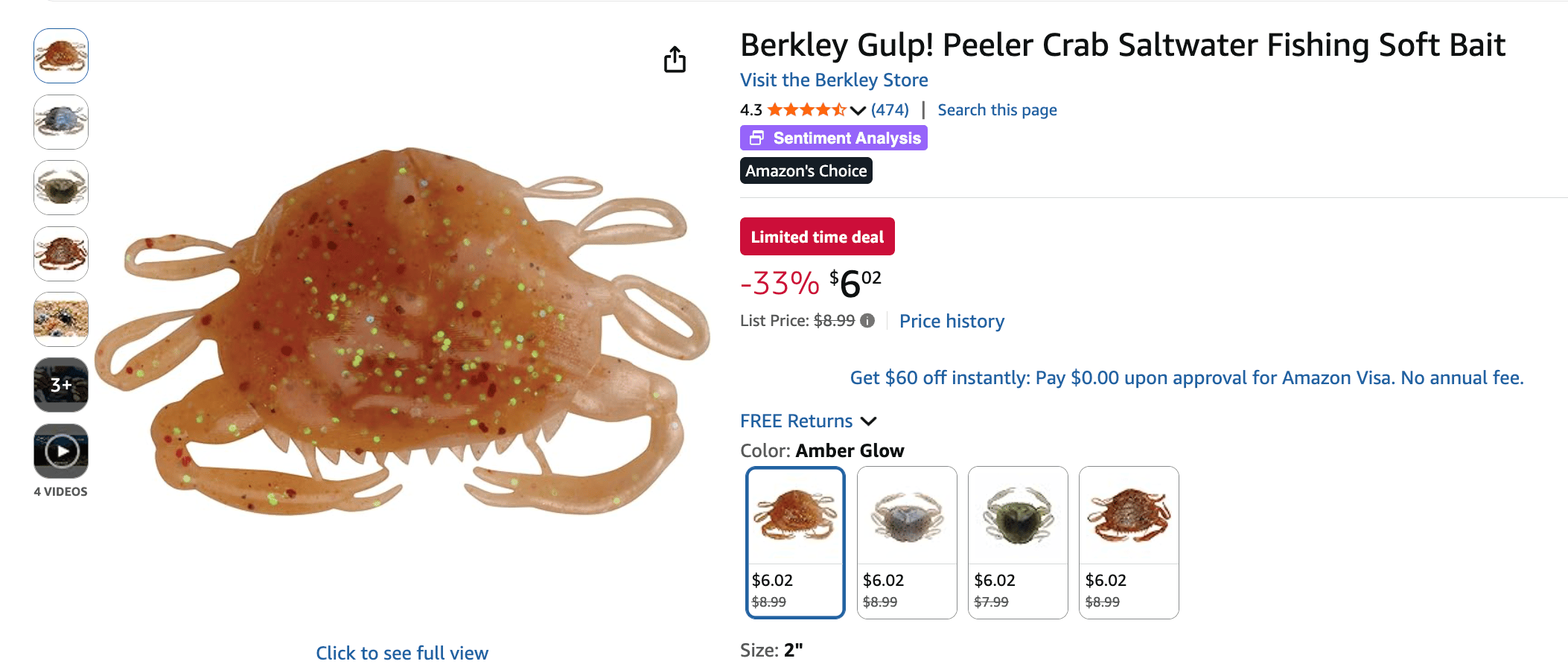
Take this example. It’s literally a tiny plastic crab fishing lure selling for about $6.02. Not exactly the type of product most Amazon sellers dream about launching. No fancy branding. No groundbreaking innovation. No massive revenue.
Yet this “stupid little crab” is quietly moving around 319 units per month.
That’s roughly $1,900 in monthly revenue for something that probably costs about $1 to produce and sits in the Fishing Soft Plastic Lures category with only one competitive FBA seller.

This is not a million dollar product. Nobody is building a Lamborghini fund selling plastic crabs for six bucks.
But that’s not the point.
The real lesson here is how unexpected products continue to sell simply because there is demand.
Fishermen want something that mimics real bait. This lure solves that simple problem. It doesn’t try to be revolutionary. It just exists because the market wants it.
And what surprises me every time is how often products like this appear when you start digging through Amazon data.
You think the market is saturated. You assume every possible idea already exists. Then suddenly you discover something simple, almost ridiculous… quietly selling hundreds of units per month.
Which brings us back to the earlier lesson.
Sometimes the opportunity is not a sophisticated invention. Sometimes it’s just noticing that people are already buying something simple, and asking yourself one question:
Could this be done slightly better, slightly smarter, or packaged in a way that actually builds a brand?
Because the market doesn’t reward complexity.
It rewards products people actually buy.
The market doesn’t pay you for building something cool. It pays you for building what people are already looking for.
Happy Thursday!
See you in 2 weeks!
Izabella